Category Archives: Uncategorized

“There’s a nap for that!”: YouTube videos of young children using Apple devices (Part two)

Much of the discussion surrounding very young children’s media use is often of a protectionist nature against negative effects, or conversely proselytizes educational benefits of digital technology.  As noted in part one of this post, rich insight can be gained by framing the discussion rhetorically, specifically analyzing the domestic uses of technology in the form of parent-posted YouTube videos of babies and toddlers using the iPhone, iPad, and iPod Touch.

***

Method

A purposive sample of 85 amateur YouTube videos was selected, accessed from October 15 to November 26, 2010, and originally uploaded between July 6, 2007 and October 31, 2010.  These clips were located via searching for either the terms “baby,” “babies,” “toddler,” or “toddlers” in combination with either the words “iPhone,” “iPad,” or “iPod Touch.” Of parents who explicitly noted their child’s age, the range was from 2-months to 3-years-old.

Three main elements of each YouTube video were considered as text for the rhetorical analysis: the audio-visual of the YouTube clip itself, the title that the user gave to the video, and (if provided) the description for the video that the user posted in the provided space on screen below the clip.  The videos mainly featured American parents and young children, but also included a number of families from Europe and Asia, providing some geographic, cultural, and ethnic diversity.  Most of these videos were filmed at home, with a few shot at the Apple store.  Few of the various textual sources provided information about what recording device was used to shoot the video.

Results

Three main categories of parents ’ construction of the image of their children emerged from the sample: (a) children “acting their age” (b) children as exceptional or “acting above their age” and (c) Apple technology as exceptional.  The videos in which children were “acting their age,” parents made no claims about the child being exceptional or advanced for their age.  For the videos in which children were presented as “acting above their age,” parents expressed in various ways that their child was more exceptional than other children, than other adults, or were exceptional at either explicitly or implicitly promoting Apple products.  The other common theme was of placing a strong emphasis on the technology itself as being transformative.  Note that some individual videos presented multiple themes, and are not restricted to one category or another.

Children “Acting Their Age”

Many videos presented children’s interactions with Apple technology as “cute.”  Humor was primarily derived from bodily functions, parental experiments with very young children’s behavioral temperament, and babies using the iPad as a “mirror.” The device served as both a reflective surface, but also as a reflective tool for viewing pictures and videos of both the babies themselves and other babies as well.

There were a number of video recordings shot from the iPhone while the device was in the child’s hands, the camera was on, and the camera was facing the child.  Nearly all of the videos shot in this manner featured a baby attempting to lick or put the iPhone in his or her mouth (one entitled “Baby eats iPhone”).  Another video showed a mother trying to dissuade her child from putting the mother’s iPod Touch directly into the boy’s training toilet (entitled “iPotty training”).  Humor was also derived from the bodily function of a child sneezing onto an iPad and rubbing the snot on it (entitled “KID SNEEZES ON IPAD HILARIOUS!!!”).  Another video was entitled “Cute 8 month old baby on the toilet potty training w/ iPad.”  The children in these videos were primarily interacting with the physical hardware and not manipulating the device’s software.

Another recurring theme was parents using the Apple device as a prompt for behavioral experimentation with their young children.  Some prompts were more explicit than others. For example, in one video, a parent positioned two babies to sit next to each other, one holding an iPhone and the other child looking on.  The baby holding the iPhone threw a fit when the other baby attempted to touch the device.  In other cases, parents themselves used the device to solicit a desired response from the child.  For example, some videos showed babies crawling to iPads that their parents had purposefully put just out of reach of the child, in order to prompt their child to crawl towards it.  In one entitled “Luke walking to the IPhone,” the iPhone’s forward facing camera recorded the child walking towards the device.  While some parents attempted to evoke forward movement such as crawling or walking, other parents used the device to pacify their child and stop them from crying.  There were videos of babies crying and caught on video being instantly quelled by having an Apple device put in front of them.  Conversely, videos like “Baby iPhone Addict” and “iPad Toddler Tantrum” demonstrated a very young child crying upon having an Apple device taken away from them.

One video (above) in the sample was different from the rest in that the video showed a parent supporting their child’s use of an iPhone application in a way that was developmentally prosocial in terms of communication style but antisocial in content.  That video was entitled “2 year old using iPhone. Shotgun by a 24 month old baby boy!”  It showed a father providing positive physical and verbal feedback to his child’s simulated gunplay with the “Shotgun” iPhone app.  In the video, the father asked the child “What’s that?” pointing to the icon for the “Shotgun” app.  The baby responded “Pow pow!” and retrieved the Shotgun app, to which the father asked, “How do you make it go ‘Pow pow’?”  The baby then shook the iPhone in a forward motion and the phone made a lock and load sound.  The boy then smiled and said “Pow pow!” to which father went “Alright!”  The content on the Apple devices allows for multiple types of learning as scaffolded by the parent, learning content that is not necessarily prosocial.

A number of babies also used the Apple devices for looking at still pictures of themselves or of their families, or videos of YouTube clips of other babies.  In terms of babies watching YouTube videos, in one video a child watched the aforementioned viral video “Charlie bit my finger – again!” Another video shows a baby watching a video of a laughing baby on her mother’s new iPad.  The child is transfixed and giggles in response to the giggling in the video.  In another clip entitled “Baby Sadie watches Babies Trailer on iPad,” the parent describes the video as “Here’s my 6 month old daughter watching the Babies Trailer on a new iPad. Talk about multi-layered marketing.”  Babies, a 2010 documentary looking at the lives of four babies from around the world, provides the opportunity for the child to mirror another very young child’s emotions and facial expressions.  Meanwhile, the parent’s uploading of the video serves in some ways as an advertising tool for both the movie and Apple within the YouTube space.

Children as Exceptional or “Acting Above Their Age”

Another type of video demonstrated parents fetishizing their children’s perceived extraordinary nature, whether their children were extraordinarily intelligent and/or mature.  Three main themes were identified for ways in which parents promoted their child’s exceptional nature, 1) in terms of their child being smarter than other children, 2) being smarter than the general population or those much older, and 3) of their children being exceptional advertising vehicles for Apple products, as a briefly alluded to in the earlier example of the baby watching the Babies trailer example.

1) Children as more exceptional than other children.

Various parents promoted the rapid pace of their child’s perceived mastery of the Apple devices.  Many indicated that their young child “instantly” learned how to use the gadget.  One parent wrote that their 20-month-old child “mastered the iphone months ago.”  Another described their child playing a piano iPad app (of which there were many babies playing piano apps videos) as a “Mozart baby,” invoking the Baby Einstein moniker and the much-debated link between classical music and the intellectual growth of very young children.  Another mother wrote of her child’s ability to distinguish between single- and multi-touch devices, “She even knows that her other fingers shouldn’t be touching the screen.”  Quite a few videos also demonstrated parents marveling not over their child’s navigation of the specific applications, but rather their child’s ability to “unlock” the iPhone.  Many of the children in these videos were praised for the ability to do so by their parents.  It is unclear from these videos if the child also understood the non-digital key/lock referent.

Some of the videos were more explicit about directly comparing one’s child to other children.  Through clip titles and descriptions, a large number of videos in the sample demonstrated parents labeling their child as the “world’s youngest” or “the real youngest” iPad, iPhone, or iPod Touch user or as an “iPhone kid genius.”  Some parents also demonstrated self-awareness to this hyperbole, as one father noted of his child, “He’s a genius. (Well, at least his dad & mom think so.)”  Other parents evoked norms by describing their children as “more than average.”  Consider this video description:  “My sweet little boy is just an average boy doing just a little bit more than the average kid to be independent more and more each day.. Mind you he is just a one yr old boy.. (He first used the ipad when he was 16 mos old)  now i wonder if he is the youngest ipad user today.. =)”.  While the example initially validates normativity, in increments the parent represents the child as above the norm, from an “average boy” to the “youngest ipad user today.”  Some videos ironically juxtaposed normativity and exceptionality.  One video, described as “Three-month old prodigy Ilan Peter Oren performs selected works on the iPad piano” was introduced by an iMovie title screen with a red curtain that parts, flickering candelabras, and a gothic-style lettered title “Great Performances.”  This polished production value is purposefully contrasted with the child’s limited range of motion as well as his spitting up about 50 seconds into the one minute and 25 second video.

2) Children as more exceptional than adults.

Some parents positioned their children as exceptional by deemphasizing their own role in their children’s learning, as well as generally comparing their children to the older general population.  In a few cases, parents asserted their child’s exceptional nature in relation to not needing intervention from adults in order to master the Apple devices.  As one parent described their video, “My son has now learned how to turn on the iPhone, unlock it and flip through his favorite photos. He hasn’t had much coaching to learn this. He just watches me using it.”  The parent downplays their own active teaching role in favor of promoting their child’s observational learning.  Independence was a popular theme.  Another parent wrote, “He knows how to operate the ipad on his own.. From turning it on, going to the menu, choosing the applications that he likes and playing with them.. =) He is all on his own when he uses the ipad and alot of other things actually.. he is quite an independent kid!”  This is not to say that parents who described their children as exceptional did not also acknowledge their child’s limitations.  For example, as another parent described, “we just wanted to show everyone that even a 22 month year old baby girl who can barely even talk can play a sophisticated device like the apple ipod touch.  she learned this by just watching us play games on the ipod touch.  i had to record the video behind her so she does not know she was being recorded because if she knew she would have paid attention to the camera.”  In another video, an edited short movie entitled “iPhone Baby PWNAGE!!!” a baby shows a befuddled father how to turn on his iPhone.  There was an interesting dynamic in these videos between attributing the child’s exceptional nature to the parents or the children themselves.

A number of videos also contrasted the child’s dexterity with the devices to the general population.  Unlike non-experts, one child “knows how to use the phone like a pro.”  One tongue-in-cheek video was subtitled “If i phone, uCan too!” which the user described as “How to use the functions on your iPhone” by her 1-year-old daughter.  In another YouTube clip, a toddler unlocked an iPhone and wove it around as he danced and bopped around to James Brown’s “Living in America” in his carpeted home hallway in front of a laundry basket (entitled “iPhone: You’re never too young for one”).  The child was thus framed as enjoying the device in a way that “you” might.  Additionally, in the aforementioned Shotgun app video, the parent compares the child to other relatives, noting in the description, “My son loves my iPhone.  He is more efficient at it than his grandmother.”  These videos compare and contrast their child to the population-at-large.

3) Children as exceptional advertising vehicles.

Another recurring theme was children personifying and promoting the Apple commodity.  Some videos were explicitly promotional, such as the testimonial clip entitled “Baby and the iPad – Uzu App Review (by a 4 month old).”  In the video description, there was a link to the mother’s own blog of digital media reviews.  And at the end of the clip, there was also an on-screen caption (“2 slobbery thumbs up for the Uzu app”) placed over a still frame of the smiling child.  A description accompanying another video linked to the iTunes page for the app being demonstrated by the child, and claims that the app would “make your babies even cuter!!!”

While some videos promoted apps, which are generally produced by companies other than Apple, some of the videos presented children mimicking the Apple brand.  One video was actually a 30-second mash-up of one of the original existing Apple commercials for the first generation iPhone and home footage of a parent holding the iPhone above their baby like a crib mobile.  The re-recorded vocal track played over the commercial’s iconic acoustic guitar track.  The ad copy was modified to say, “With the iPhone, you can listen to your favorite songs.  You can even check your email.  Not only that, you can surf the Internet and watch your favorite movies.  Even better, the iPhone is now a pacifier for your baby.”  And in perhaps the most explicit Apple fan video, entitled “Baby Steve Job’s iPhone”, a 2-year-old dressed up as Steve Jobs for Halloween, in Jobs’ uniform of high-waisted jeans, a belt, and a black turtleneck. The child also held the plastic case and cardboard insert replica of the iPhone that generally comes with the phone’s packaging.

Apple Devices as Exceptional

Some videos more than others fetishized the iPad, iPhone, and iPod Touch.  This praise manifested in two ways: one, in terms of displaying the newly purchased Apple device as a display of wealth, and second, in terms of the benefits of the technology for children with disabilities.

By posting a video of the child playing with the newly acquired device, a number of parents asserted their socioeconomic status.  The chronologically earliest videos in the sample were created shortly following the release of the first generation iPhone, and there was a large spike in sampled videos produced in early April 2010 following the release of the first generation iPad.  Some videos featured parents or children opening the box and removing the item from its original packaging.  One video (above) displayed a father performing this action, followed by positioning the iPad into his baby’s arms as if cradling the device.  This ritual seemed much like the modern American traditional photo of children taken in professional photography studios in homes or at Sears, in which the child holds an arbitrary stuffed animal or toy like a prop, as the child is too young to understand the item. Other parents distinguished that this was a gift unlike any other gift, as one described, “My child loves the iphone more than any of the 100 toys we bought him.” In these case, the handheld Apple devices are tender gifts for the child to grow into, and love much as the parent loves it.  As many parents keep such items as an iPhone or iPad physically close enough to constantly touch, demonstrating their child’s proficiency with these singularly significant devices reflect the parent’s physical and emotional bond between and betwixt their child and their devices.

Other videos focused on the transformative properties of the Apple devices for children with special needs.  Consider the following video description about one parent’s son:

His speech, understanding, word recognition, and even hand eye coordination have improved within just a short while!! I am so amazed and thankful for this amazing learning tool that my son has! I wanna say thanks to Apple and all those that have given my child such a head start in life with this amazing instrument! My son can read tons of words now, he knows every animal and dinosaur and he just turned 2 years old!!!! If you have a child around 2, don’t rob him/her of knowledge, go buy him/her an iPad!

Some of these videos were intended for the audience or community of other parents of other children with disabilities as a form of social support and testimony about the devices.  These videos primarily featured children with cerebral palsy and autism using the iPad, and on the whole these children tended to be a bit older in age than the foci of analysis.  These videos merit a richer analysis than.  For example, one mother posted a series of videos of her son’s use of the iPad, which she described as a “tool not a toy.”  She described during one such video how “This time I made it more challenging for C. Using the TapSpeak app like a Big Mac switch he used the iPad as a communication tool/AAC device instead of a toy and was much more satisified.”  This parent did not seem to express the sentiment that the technology was more exceptional than her child, but rather that the technology was so powerful because it gave her child the opportunity for self-expression.

***

Through a textual analysis of the audio-visuals, video titles, and video descriptions, these clips help us understand the role communication technologies play in the interactions between a select demographic of mostly US parents and very young children.  In my next post, I’ll discuss how these videos are parents’ public displays of their own and their child’s economic, social, political, and cultural capital and the relationships embedded in these displays.  In turn, the public presentation of the digital YouTube asset speaks to children’s current and future value, visibility, agency, and identity within their families and to a commoditized society.

“There’s a nap for that!”: YouTube videos of young children using Apple devices (Part one)

When people ask me what I study in grad school, I usually respond in one of two ways:

1) A rounded explanation of how I am interested in families with young children, and the ways that digital and analog technologies play a role in shaping psychological, social, and literacy development, or,

2) I say that I basically study “babies and iPads.”

The latest video of the “babies and iPads” genre, below, claims that for a 1-year-old, “a magazine is an iPad that does not work.”

Earlier this year, I spoke at the annual Digital Media and Learning Conference (2012 conference website) on this topic and a textual analysis I did on the increasing amounts of these types of YouTube videos.  While theoretically, conceptually, and methodologically, my study was underdeveloped (at least, so says two different academic journal rejections,) I figured that instead of making revisions and going through the lengthy resubmission process, that if I posted the revised version here and it got a conversation going in a more public forum, then my work wouldn’t go completely to waste.

***

Two of the most globally viewed viral YouTube videos to date – “David After Dentist” and “Charlie bit my finger – again!” – feature very young children as filmed by their parents in domestic spaces: the backseat of the family car and a cozy armchair in the home, respectively.  One growing category of viral YouTube videos features very young children (approximately 6-months to 3-years-old) and sometimes their parents as well playing with the parents’ Apple touchscreen devices.  The most popular of these YouTube videos, “A 2.5 Year-Old Has A First Encounter with An iPad,” has well over one million views.  Of the video, which was posted three days after the release of the first generation iPad, Mashable wrote, “For a company who prides itself on making easy-to-use products, this kind of unsolicited marketing is pretty much pure gold [for Apple].  The litmus test for ‘user-friendly’ until recently was ‘can my mom use it?’ Increasingly it might become ‘can my toddler use it?’”

In regards to technology and family practices, the above quote alludes to a potential evolution of norms concerning utility and usability.  Within a family, is it more important for technology to be ‘so easy, even older adults can use it?’ or ‘so easy, even a baby can use it?’  The Mashable article presupposes that this moment in time might be a critical juncture in generational relationships surrounding technology, with the parents of young children (who are themselves children of older parents) caught in the middle.  Many of these parents of very young children are young enough to be considered “digital natives” themselves, to employ the oft-misused term.

The Mashable article suggests that Apple devices might increasingly benefit the young (the future consumer and learner) more than the old.  Currently though, relatively few children possess their own Apple devices, as the gadgets primarily belong to adults or are shared among the family.  Since a device such as an iPad is a costly investment, upper-middle class families may feel the need to justify the purchase, and so insure that even the youngest and oldest family members can benefit from the device.

With the production and circulation of these YouTube videos featuring very young children using iPhones, iPads, and iPod Touch devices, children (with the aid of their parents) are producing Apple as we come to know it.  Videos like “A 2.5 Year-Old Has A First Encounter with An iPad” and “A Magazine Is an iPad That Does Not Work”  present a window into the generational ownership dynamic surrounding Apple gadgets, a form of what Foucault termed “technologies of the self.”

The videos demonstrate how both the technological device and the child are both a form of the parent’s progeny.  Both are deeply personal replications and extensions of the parent, though the child has more individual autonomy than the device.  The parent determines his or her device applications, settings, and preferences, and also separately for the child.  Thus these videos may serve as evidence of a sort of “double second self” for the parent and child, to borrow Sherry Turkle’s conceptualization of the relationship between children and technology.  The child is a reflective of the parent, and parents are also shaped by their experiences with their children.  As the child is interacting with technology (that is itself reflective of the parent), the technology is responsive to the child’s tactile and emotional feedback.  These devices are both the adult and the child’s toy.  For instead of children being told to share his or her toys, some parents in the aforementioned YouTube videos symbolically model sharing their toy with their child.

These YouTube videos are artifacts of the domestic use of one technology (video cameras) to capture and curate the domestic use of another (touchscreen handheld Apple devices).  Not all children and parents are taking part in this (re)production.  While YouTube may be a relatively accessible platform for those with the Internet bandwidth and recording technology, the ownership of the specific Apple devices featured in these videos is tied to demographics.  There is a large price differential between a newly released iteration of an iPad and a hand-me-down first generation iPod Touch.  Children have historically served as statements of class status, from the school one’s child attends to the social networks thus created.  Publicly posting one’s child playing with an expensive device makes that wealth visible to a technological community.

These YouTube videos are but one way for both parent and child to perform their technical affiliations and mediated experiences.  There is much to be written by cognitive and developmental psychologists about the usefulness of touchscreen technology in education, and about how much or how little time children should spend in front of and engaging with screens, or the content on those screens.  However, there is a scarcity of literature on how parents may be constructing the image of their child as technologically proficient, via the YouTube network.

These videos allow caregivers to construct versions of a parent-child dynamic in relation to technological innovation. They invent the child as expert, using technological literacy as form of social currency.  While there are a variety of toys on the market that are child-friendly toy versions of Blackberry phones and e-readers, such objects are distinctly for the child and not the adult primarily.  The parents posting these videos have chosen instead to focus on their children playing with the grown-up toy, showing how the adult makes space in their life and on their device for their child.  These videos offer an interesting commentary on the “pass-back” effect phenomenon, which implies that once a parent gives their device to a child, the parent has no contact with either the child or the device until the child “passes-forward” the device.  In order for the YouTube video to be taken though, there must be an adult present, some who are actively using the device with the child, and others who are unseen behind the camera.  The degree of active participation on the part of the parent who has passed-back the device also varies during the entire course of time in which the child is engaged with the device.

***

Considering the critical discourse on modern parenting in relation to technology, last semester, I undertook an exploratory analysis of YouTube videos of babies and toddlers using the iPhone, iPad, and iPod Touch.  Many parents posting these videos are “early adopters” in a dual sense – early in terms of buying the device close to its release date, and also adopting the device in the early stages of their child’s development.

How might these videos help us understand the role communication technologies play, as both physical and symbolic objects, in the interactions between parents and very young children?  In my next post, I will describe the themes that emerged from the approximately 80 YouTube videos I analyzed, and the implications for parent-child relations.

Digital Divide(s) in “The Diamond Age” (Part 3)

In The Diamond Age: Or, A Young Girl’s Illustrated Primer, not all young girls or all Primers are considered or created equal.

Hackworth’s punishment for making his own illegal copy of the Primer is to engineer a new version of the Primer that can be mass produced for hundreds of thousands of four-year-old orphaned Chinese girls under Judge Fang’s supervision.  Seeing as Nell, Elizabeth, and Fiona’s copies of the Primer require adult ractors on the backend, the labor force and capital needed to sustain a quarter-million illicit copies could not go undiscovered by Lord Finkle-McGraw.

So Fang orders Hackworth “to make alterations in the Primer so that it is suitable for our requirements – we can make do without those parts of the book that depend heavily on outside ractors, and supply our own ractors in some cases” (Stephenson, 1995, p. 179).  The family components of the Primers, the caregiver ractor/child relationships, are the very parts that the orphans are made to do without.

Within these stripped down Primers, Hackworth devises “a trick” – vaguely making “changes in the content so that it will be more suitable for the unique cultural requirements of the Han readership” (Stephenson, 1995, p. 179-180).  Such is the perilous nature of outsiders alone defining those “unique cultural requirements:”

[He/Judge Fang] squatted so that he could look [her/the Han orphan girl] in the eye and handed her the book.  She was much more interested in the book than in Judge Fang, but she had been taught the proper formalities and bowed and thanked him.  Then she opened it up.  Her eyes got wide.  The book began to talk to her.  To Judge Fang the voice sounded a bit dull, the rhythm of the speech not exactly right.  But the girl didn’t care.  The girl was hooked. (Stephenson, 1995, p. 244)

Though hundreds of orphaned Chinese girls in TDA are granted equal access to Primers – just as New Atlantis/Shanghai girls Nell, Fiona, and Elizabeth are given Primers by seemingly benevolent paternal figures – these adapted, mass-produced interactive books are in crucial ways different from the Primers given to the New Atlantan girls.  Though the Primers that Hackworth engineers for the orphans attempts to address some aspects of one type of “digital divide” – that of one basic degree of access – they exacerbate other key inequalities, such as the lack of personalized scaffolded learning, and they simulate pseudo-emancipation for the nameless young women.

Digital divides and ICTs in transhistorical and multicultural perspective

One can slice the digital “divide” into any number of components (Hargittai, 2010; Hassani, 2006; Livingstone & Helsper, 2007; Selwyn, 2004, 2009; Warschauer, 2002).  The term “digital divide” can address a myriad of disparities and populations depending on who uses it to advance which argument/agenda.  Instead of an access/no-access binary, some have considered access as degrees on a spectrum (Clark, Demont-Heinrich, & Webber, 2005; Clement & Shade, 2000).  The gaps in children’s home and/or school access to digital technology cannot be isolated from the content of that digital material (e.g. online community “walled gardens”); variations in immediate environmental context surrounding that access (e.g. shared usage on slow dial-up in public libraries versus a personal bedroom laptop with a high-speed connection); and social variables such as age, income, gender, race, ethnicity, education, and geography (Buckingham, 2007; Ito et al., 2009).

The incorporation of media and ICTs within institutional education has the potential for both facilitating and undermining participatory culture.  Digital inequalities must be examined within their ecological context and understood with regards to the social dynamics of self and collective efficacy (Hampton, Livio, & Sessions, 2010).  The content of digital material, such as the lack of diverse online avatar options for children, can be a barrier to access in and of itself (Kafai & Peppler, 2011).  Even with hardware and software access being equal, not all children have developed the skills and knowledge to fully participate in civic engagement, can comprehend the opaque influence of media, nor work through the ethical complications that in many ways define the modern Internet (Jenkins, Purushotma, Clinton, Weigel, & Robison, 2006).

A “scaffolding gap” may create another chasm among young children (often low-income and ethnic-minority) who are less likely to have adult guidance and dialogic support when using the Internet at home (Gutnick, Robb, Takeuchi, & Kotler, 2011; Neuman & Celano, 2006).  Children with special needs are often left out of the discussion of digital inequalities entirely, as the digital playground is in many ways inaccessible for children with disabilities to develop multi-modal literacy skills (Baird & Henninger, 2011).

There is a danger in naturalizing or fetishizing the phrases “digital natives” or “digital immigrants” (Prensky, 2001), which frames immigrant status in a pejorative manner and may downplay the role that experienced adults may have in supporting youth’s early media experiences.  Not all children “grow up” with technology or perceive it as a “natural” part of life – at least not technology in the Western industrialized sense.  Children have rich developmental potential for recognizing invention and becoming innovators on a daily basis, for moving seamlessly between playing in the sand to manipulating digital bits.  Even making the transition from the thick crayon to the thin crayon, and using that technological advancement to create a more fine edged drawing is itself part of children’s process of internalizing and mastering invention and innovation.

Advancing from thick crayons to thin crayons as technological innovation. Courtesy of http://2.bp.blogspot.com/_6Y2QnLNr_Ak/TA-jOYCL2ZI/AAAAAAAADYE/qUvGxqcbn1Q/s1600/DSC_0001.JPG

It is not enough to focus on the present state of ICTs in education on local, national, and global levels.  We must challenge ourselves to think about what the digital divide(s) looked like before there was a “digital,” (Cassell & Cramer, 2008; Seiter, 2007).  In turn, Stephenson’s book is helpful in provoking discussion of what these ever-evolving inequalities might look like when technology has moved beyond digital into nanotechnology.  Historicizing the relationship between youth and technology when “old technologies were new” (Marvin, 1988) is essential for imagining and preparing for when today’s new technologies will inevitably be old, as in TDA.

The Chinese girls’ use of the limited version Primer in TDA is in stark contrast with the rich origins of moveable type in China, though popular history textbooks attribute the lion’s share of credit to Guttenberg.  Literary scholar Greta Aiyu Niu (2008, p. 78) writes in her commentary on what she terms “techno-Orientalism” in Stephenson’s book, “The fantasy of The Diamond Age erases China’s history of technological innovations.”  Niu defines techno-Orientalism in terms of these complicated and often contradictory dynamics between capitalism and consumption. Techno-Orientalism essentializes the notion of a singular digital divide, removing gradations of the social, ethical, and political (Nakamura, 2004).  In TDA, the Han tribe of Chinese peoples is dependent on reproducing and copying Western ingenuity, and the Chinese girls who receive the Primers are symbiotically-dependent on Nell’s version of the text.

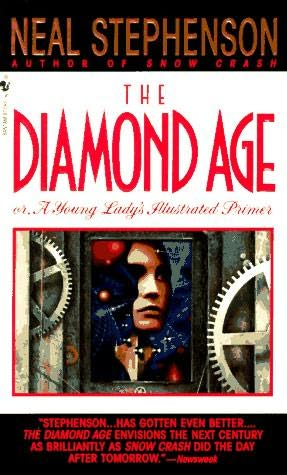
Cover of The Diamond Age by Neal Stephenson. 1995 Viking edition. Highlighting the "mouse army" allegory.

Princess Nell’s conflicted solidarity and sisterhood with her “Mouse Army”

Though the Chinese orphans (or Princess Nell’s “Mouse Army” within the fantasy narrative of the Primer) have access to their own nanotech Primers, the makeup of those Primers and their ultimate purpose exacerbates other political and social inequalities.  This representation of Chinese females and femininity in TDA is enmeshed in discourses of agency, gender, and ethnicity.  China’s “one child” policy of family planning is alluded to as the cause of the girls’ abandonment, possibly perpetuating stereotypes of Chinese girls as unwanted.

Nell, a Caucasian girl, is held up as the ideal user of the Primer, but her progeny do not have similar opportunities to practice and participate.  Like the orphans, she too is an abandoned, impoverished girl.  Primers, rather than biological families, raise Nell and the Chinese girls. However, Nell benefits from Miranda’s personalized instruction while the orphans are treated uniformly.  Writes Niu of the orphans, “In The Diamond Age, though they, too, learn nanotechnology from their primers, not one of the 333,000 prepubescent Chinese girls who empower Nell as their leader is ever named or even tasked with anything other than physical labor” (Niu, 2008, p. 89).  Nell can also “pass” as New Atlantan bourgeois when presented with the opportunity to escape, while the orphans have no options or opportunities.

Nell is their liberator from an enchanted spell, their long sought-after queen who can turn them from allegorical mice into real girls; trapped in limited, meek bodies.  This fable potentially mythologizes Nell as the colonizer within a discourse of late nineteenth- and early twentieth-century British imperialism.  Niu writes of the Chinese orphans:

Although the unnamed girls study ‘tutorials’ (Stephenson, 1995, p. 461) about nanotechnology in their primers, they are never given the opportunity to engineer anything; indeed their efforts are all for the sake of, or at the behest of, their sovereign leader.  These girls are unindividuated cyborgs whose value lies primarily in their immense numbers, their reverence for authority, and their fanatical devotion to their primers (suggesting a cheeky reference to Mao’s Little Red Book) (Niu, 2008, p. 80).

The reader is supposed to consider Nell the heroine, but what of the individual voices or stories of the girls who ultimately come to her rescue?  I believe that there is room for alternate readings of TDA.  While Niu finds that Stephenson is promoting techno-Orientalism, his presentation also opens a space for oppositional readings (Hall, 1973, 1980) and contradictions that bring rise to debate.

The trouble with “subversion”

One such contradiction that merits further analysis is the way in which TDA handles the topic of “subversion,” both as a plot device and character trait.

The Primer supports “subversion” in the New Atlantan girls, but not in the same way with the orphans.  Lord Finkle-McGraw contracts Hackworth to engineer the original Primer to fill the gaps he perceives in his granddaughter Elizabeth’s education – gaps in exercising social, cultural, and political subversion.  In doing so, he too subverts the educational choices of Elizabeth’s own parents with a heavy handed paternalism: “Finkle-McGraw couldn’t prevent his granddaughter Elizabeth’s parents from sending her to the very schools for which he had lost all respect; he had no right to interfere.  It was his role as grandparent to indulge and give gifts.  But why not give her a gift that would supply her the ingredient missing in those schools” (Stephenson, 1995, p. 81).

Later it becomes clear that the ultimate goal of this planned subversion is actually the recipient of the Primer’s subordinance.  The Primer encourages New Atlantis children to leave the neo-Victorian tribe only to return once they realize “it is, in the end, the best possible tribe” (Stephenson, 1995, p. 365).  While perched from a place of privilege, the subversive pendulum is designed to inevitably swing back.

Digital humanist David Leech Anderson writes on TDA: “It may be something of a dramatic flourish to call this sought after property, ‘subversiveness.’  If we aren’t careful, it could easily be reduced to something no more substantive than a bumper sticker that reads ‘Question authority!’” (Anderson, 2008, p. 15).  Finkle-McGraw defines subversive thinking as the ability to grapple with subtlety and ambiguity.  Stephenson, in presenting this leitmotif in rather contradictory ways, challenges readers to think subversively about “subversion” in TDA itself.

The myriads of proposed solutions for bridging the digital divide(s) often contradict or cancel each other out.  When the economic foundation of the high-tech market is planned obsolescence, each new Primer or piece of digital technology can only temporarily simulate pseudo-emancipation.  “Critical thinking” and “subversion” mean different things to different populations of children – not independent of cultural, racial, and socio-economic background.  The problem with sustaining a univocal definition of subversion is also a commentary on the trouble with conceiving of technological access as an essentially democratizing force.  The experience of the “Mouse Army” is reminiscent of Alan Kay’s early blueprints for the Dynabook and the One Laptop Per Child program.  In terms of sustainability and cultural change, what kind of education does the Primer introduce, and what other forms of indigenous education might it displace?

References

Anderson, D. L. (2008). Humans using machines, humans as machines: Implications for teaching and learning. Humanities and Technology Review, 27, 1-23.

Baird, C., & Henninger, M. (2011). Serious play, serious problems: Issues with eBook applications. Cosmopolitan Civil Societies Journal, 3(2).

Buckingham, D. (2007). Beyond technology: Children’s learning in the age of digital culture. Malden, MA: Polity Press.

Cassell, J., & Cramer, M. (2008). High tech or high risk: Moral panics about girls online. In T. McPherson (Ed.), Digital youth, innovation, and the unexpected, The John D. and Catherine T. MacArthur Foundation Series on Digital Media and Learning (pp. 53-76). Cambridge, MA: MIT Press.

Clark, L. S., Demont-Heinrich, C., & Webber, S. (2005). Parents, ICTs, and children’s prospects for success: Interviews along the Digital “Access Rainbow.” Critical Studies in Media Communication, 22(5), 409–426.

Clement, A., & Shade, L. (2000). The access rainbow: Conceptualizing universal access to the information/communication infrastructure. In M. Gurstein (Ed.), Community informatics (pp. 32-51). Hershey, PA: Idea Publishing.

Gutnick, A. L., Robb, M. B., Takeuchi, L., & Kotler, J. (2011). Always connected: The new digital media habits of young children. New York, NY: The Joan Ganz Cooney Center at Sesame Workshop.

Hall, S. (1973). Encoding and decoding in the television discourse. Birmingham, UK: Centre for Cultural Studies, University of Birmingham.

Hall, S. (1980). Encoding/decoding. In S. Hall, D. Hobson, A. Lowe, & P. Willis (Eds.), Culture, media, language. London: Hutchinson.

Hampton, K. N., Livio, O., & Sessions, L. F. (2010). The social life of wireless urban spaces: Internet use, social networks, and the public realm. Journal of Communication, 60(4), 701-722. doi:10.1111/j.1460-2466.2010.01510.x

Hargittai, E. (2010). Digital na(t)ives? Variation in Internet skills and uses among members of the “‘Net Generation’.” Sociological Inquiry, 80(1), 92-113.

Hassani, S. N. (2006). Locating digital divides at home, work, and everywhere else. Poetics, 34, 250–272.

Ito, M., Baumer, S., Bittanti, M., boyd,  d, Cody, R., Herr-Stephenson, B., Horst, H. A., et al. (2009). Hanging out, messing around, and geeking out: Kids living and learning with new media. Cambridge, MA: MIT Press.

Jenkins, H., Purushotma, R., Clinton, K., Weigel, M., & Robison, A. J. (2006). Confronting the challenges of participatory culture: Media education for the 21st century. Chicago, IL: The John D. and Catherine T. MacArthur Foundation.

Kafai, Y. B., & Peppler, K. A. (2011). Youth, technology, and DIY: Developing participatory competencies in creative media production. In V. L. Gadsden, S. Wortham, & R. Lukose (Eds.), Youth cultures, language and literacy. Review of research in education (Vol. 34).

Livingstone, S., & Helsper, E. (2007). Gradations in digital inclusion: Children, young people and the digital divide. New Media & Society, 9(4), 671-696.

Marvin, C. (1988). When new technologies were old: Thinking about electric communication in the late nineteenth century. Oxford, UK: Oxford University Press.

Nakamura, L. (2004). Interrogating the digital divide: The political economy of race and commerce in new media. In P. Howard & S. Jones (Eds.), Society online: The internet in context (pp. 71-83). Thousand Oaks, CA: Sage.

Neuman, S. B., & Celano, D. (2006). The knowledge gap: Implications of leveling the playing field for low-income and middle-income children. Reading Research Quarterly, 41(2), 176-201.

Niu, G. A. (2008). Techno-Orientalism, nanotechnology, posthumans, and post-posthumans in Neal Stephenson’s and Linda Nagata’s science fiction. MELUS: The Society for the Study of the Multi-Ethnic Literature of the United States, 33(4), 73-96.

Prensky, M. (2001). Digital natives, digital immigrants. On the Horizon, 9(5), 1–6.

Seiter, E. (2007). Practicing at home: Computers, pianos, and cultural capital. In T. McPherson (Ed.), Digital youth, innovation, and the unexpected, The John D. and Catherine T. MacArthur Foundation Series on Digital Media and Learning (pp. 27-52). Cambridge, MA: MIT Press.

Selwyn, N. (2004). Reconsidering political and popular understandings of the Digital Divide. New Media & Society, 6, 341-362.

Selwyn, N. (2009). The digital native–myth and reality. Perspectives, 61(4), 364–379.

Stephenson, N. (1995). The diamond age: Or, a young lady’s illustrated primer. New York: Bantam.

Warschauer, M. (2002). Reconceptualizing the Digital Divide. First Monday, 7(7).

Parenting in “The Diamond” (or, the digital) “Age” (Part 2)

Parenting in The Diamond (or the Digital) Age

While TDA may appear to be a book primarily about technology, there’s a compelling argument to be made that it hinges entirely on sociology and family dynamics.  Nearly any discussion of children and media in the book is deeply tied to the social interactions that parents have with their children around or through the technology that stays put or passes through their homes.

Most of the parents and ‘parental figures’ (surrogate parents or sometimes children themselves acting as caregivers) in the book are emotionally and/or physically absent from their children’s lives.  Their media choices and uses reflect this closeness/distance continuum.  These fictional future projections of parenting in the late 21st century invoke reflection upon where we are in the early 21st century and the way families have negotiated their identities in relation to media and technology within and outside the home for hundreds of years.

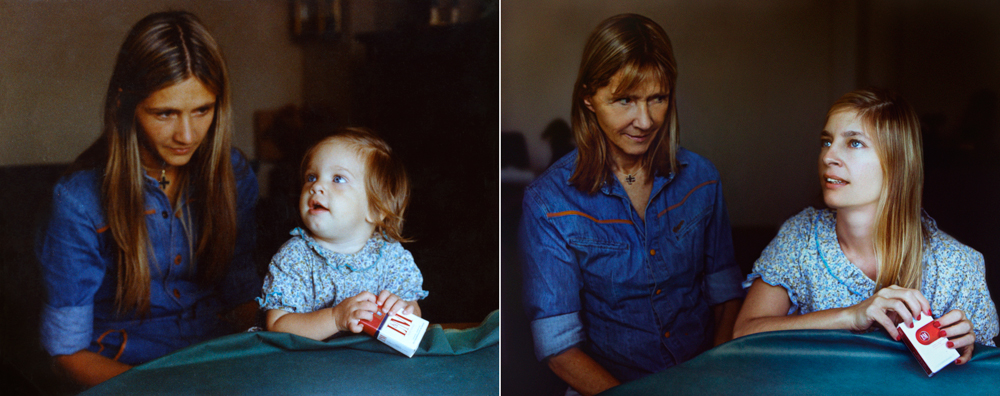
quality family time, then & now, baby playing with cigarette carton. "RITA & COTY IN 1977 & 2010, Bueno" by Irina Werning (http://irinawerning.com/back-to-the-fut/back-to-the-future/)

In the scope of humankind, “leisure time” is a relatively recent construct.  As mortality rates have decreased, due largely in part to technological advances in modern medicine and improved hygiene habits, more people spend time actually being children and parents.  We’ve come a shockingly long way from nomadic parents not expecting their children to live past age ten, to parents of young children concerned about which toys/television/movies/DVDs/books/apps to purchase for their toddler’s use at home.  “Family time” has been continuously redefined, that time consisting of laboring, relaxing, and/or playing together; the “quality” assigned to family time in a secular or religious sense; and taking place not only at home, but any place families go (e.g., within modes of transportation, at the large family picnics that pepper Los Angeles’ public parks on weekends, and in air-conditioned shopping malls globally).

There are many spheres of influence that shape the patterns of media and technology use inside/outside the home, as well as how that relates to textured relationships among families.  This ecological view of child development posits that these spheres are interdependent (Bronfenbrenner, 1979).  Ecologies of learning with media and technology (Barron, 2004; Barron, Martin, Takeuchi, & Fithian, 2009) also move across time/space and between the communities (e.g., home, school, peers) with which children interact.

Within a convergence culture, in what ways are all kinds of families contributing to how children navigate consuming, creating, and spreading media across their social environments (including family members, friends, and people whom they may never have met in person)?  There are many types of media and differing family configurations within TDA with which to explore this question.  Such permutations of “child/caregiver” units to compare within the text include:

Nell/her biological parents

Nell’s stuffed animals/Nell

Nell/her “surrogate mother-friend-tutor” Miranda

Elizabeth/her biological parents/her biological grandfather Lord Finkle-McGraw

Fiona/her biological father Hackworth

The parentless Chinese orphan girls/Judge Fong and Hackworth

The “Mouse Army” of Chinese orphan girls/Nell

Three topics related to children, parenting, and media/technology nested within the book have external relevance for researchers, educators, policymakers, and families themselves.  These areas are: 1) technologically enabled child rearing, 2) children’s restricted and unrestricted media use, and 3) surrogacy and alternative family media patterns.

Technologically enabled child rearing

We learn early on that Nell is a conceived due to a technological malfunction.  Her working class mother’s secondhand “Freedom Machine” (a euphemism for nanotech birth control) is defective.  The complicated relationship that parents and their future children have with technology begins even before conception (Balsamo, 1996; Davis-Floyd & Dumit, 1998; Taylor, 2008).  Much of the material in TDA and the content of the Primer therein are complex, violent, and dark; full of what one character calls “unreconstructed Grimm Brothers” (Stephenson, 1995, p. 219).  For example, the Primer instructs Nell on how to kill her biological mother Tequila’s abusive boyfriend with a screwdriver and how to defend herself against child molesters.

The Primer is a way for Nell to assert her own identity and agency against the harm and neglect done onto her by her domestic conditions – a way to acknowledge her victimization but denounce a sole status as victim.  For example, the book begins to “bond” with Nell after an incident in which she is verbally and physically abused by her mother’s latest boyfriend/father figure – calling her the C— word and throwing the Primer at her head – to which the book reacts instantaneously:

The book fell to the floor at her feet, open to an illustrated page.  The picture was of a big dark man and a little girl in a cluttered room, the man angrily flinging a book at the little girl’s head.  “Once upon a time, there was a little girl named C—,” the book said.  “My name is Nell,” Nell said.  A tiny disturbance propagated through the grid of letters on the facing page (Stephenson, p. 94).

Nell is not the only child in TDA to be the recipient of emotionally and physically detached parenting.  Adults in the book parent within emotional and physical boundaries, but their parenting also creates and reinforces these boundaries.  For example, Hackworth morally justifies stealing the blueprint of the Primer on behalf of his daughter Fiona: “He was just trying to secure a better place in the world for his descendents, which was every father’s responsibility” (Stephenson, p. 79).  But this paternalism results in Hackworth’s exile, paradoxically worsening Fiona’s emotional stability.  He in turn becomes the ractor in Fiona’s copy of the Primer, though her mother is not privy to this bond:

“Oh, but to Fiona, he has never been gone,” Mrs. Hackworth said. “It is the book, you see, that ractive book.  When John gave it to her, just before he departed, he said that it was magic, and that he would talk to her through it.  I know it’s nonsense, of course, but she really believes that whenever she opens that book, her father reads her a story and even plays with her in an imaginary world, so that she hasn’t really missed him at all.  I haven’t the heart to tell her that it’s nothing more than a computerized media programme” (Stephenson, p. 291).

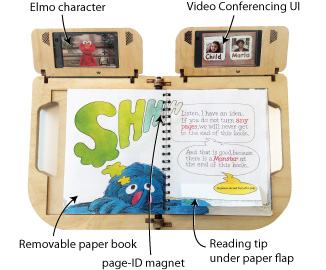
Sesame Workshop and Nokia Research Center's "Family Story Play" Project (http://research.nokia.com/page/9341)

This father and daughter’s virtual story time comes at a great emotional price.  While families have been able to use communication devices to connect with one another from a distance (not just video chat and the telephone, but handwritten letters as a sort of technology too), objects such as books and toys may soon be conduits for remote interaction as well.  Sesame Workshop and Nokia have been researching and prototyping Skype-like interfaces for children and grandparents to read interactive books together from a physical distance/close virtual proximity, using Elmo as an optional guide (Ballagas et al., 2010).  Physical dollhouses have even become tangible user interfaces for virtual communication (Freed, 2010).  Though the Primer replaces Hackworth and Fiona’s face-to-face interaction, these new technologies are designed to support communication and activities (e.g. far away grandparents supporting young children’s emerging literacy) that might not otherwise take place.

Children’s restricted and unrestricted media use

The norms for what is considered a “proper” amount or type of media use must be considered within specific cultural contexts, as is what is considered “restricted” or “unrestricted” media use, or somewhere in between.  Nell and Harv’s temporary father figure banishes them from the living room while he plays video games, and their mother falls asleep to the TV after returning from nightly overtime shifts as a housekeeper.  The upper-middle class Atlantans in the book exercise more “restrained” usage of media.  TDA illustrates this bias during Hackworth’s handover of Elizabeth’s copy of the Primer to her grandfather Lord Finkle-McGraw and his wrapping of the present with animated nanotech paper:

There was a lull while Hackworth and Finkle-McGraw watched the little scenes; one of the hazards of living in a world filled with mediatrons was that conversations were always being interrupted in this way, and that explained why Atlantans tried to keep mediatronic commodities to a minimum.  Go into a thete’s house, and every object had moving pictures on it, everyone sat around slackjawed, eyes jumping from the bawdy figures cavorting on the mediatronic toilet paper to the big-eyed elves playing tag in the bathroom mirror to… (Stephenson, p. 107-108).

There are class distinctions in being able to ‘opt-out’ of technological overload and distractions.  The mediatronic commodities are cheap, and the simple handmade goods are beyond the means of Nell and Harv’s biological mother.

Though Nell blossoms because she is largely left alone with the Primer, TDA also illustrates some ethical complications of children’s wholly unrestricted media use.  Early in the book, four-year-old Nell experiments with the screen of her home’s M.C. or matter compiler. After Nell grows too big for her crib mattress, she watches her brother Harv summon a larger one through the M.C.  First, she emulates her Mother’s usage of the M.C., and tries to talk to it.  The machine responds: “‘Please secure the permission of an adult,’ […] over and over again.  Now [Nell] knew why Harv always poked at things rather than talking to them.  She poked at the M.C. for a long time until she finally came to the mediaglyphics that Harv had used to choose her mattress” (Stephenson, p. 45).

Just because Nell can observe the interface, operate it, and work around the security setting meant to protect her/the machine/her Mother’s wallet, doesn’t mean that she has the ability to understand the impact of her actions.  After Nell makes individual mattresses for all of her stuffed animal “children,” “much of the room was covered with mattresses, and she thought how fun it would be to have the whole room just be one big mattress, so she made a couple of the very largest size.  Then she made a new mattress for Tequila and another new one for her boyfriend Rog” (Stephenson, p. 46).  Her brother Harv panics upon returning home to the scene and destroys all evidence before their mother arrives home.

This fictional example echoes recent concerns about the ease of young children’s accidental or purposeful in-app purchases while using Apple iPhone or iPad apps that are enabled to automatically make monetary transactions at the push of a button, without the assistance of a parent or guardian (Kang, 2011; Svensson, 2010).  The dexterity with which many children can navigate and workaround parental permissions point to the growing need for formal and informal media literacy education, especially while companies figure out self-regulation and the FCC considers policy reform.  While not the same as, for example, children calling 1-800 numbers from landlines and racking up the bills with a credit card taken covertly from a parent’s wallet, the potential for these automatic purchases combined with the freedoms parents cannot necessarily police necessitates conversations within families about the ethics and consequences of children’s media use (James et al., 2009).

Parental concerns about media effects have a storied history, ranging from media such as early films, comic books, television, digital media (Wartella & Jennings, 2000), and in TDA, nanotech Primers.  Many contemporary parents worry about displacement effects of media (using media instead of face-to-face interaction), replacing the time children spend in conversation with their parents or the time children spend being physically active.  Interestingly, while the majority of parents of children ages 3-10 believe displacement effects are real, only 18% reportedly indicate that their own children spend too much time with digital technology (Takeuchi, 2011).

Of course, “mediated communication” and “face-to-face communication” or “physical activity” are not mutually exclusive.  This is complicated both by physically interactive media such as the Kinect or Wii Fit, but also by media that technically facilitates face-to-face social interaction (e.g. Skype).  Another consideration is the time parents make available to their children for shared media time, and the safety of the environments surrounding children in which to be physically active and/or their ease and ability to access these outlets.

Much of the research on children, parenting, and media has to do with parental mediation of school-age children’s TV use, though less so on other types of media and with younger children.  There are different parental mediation strategies which caregivers employ: co-viewing/joint media engagement (parents watching/reading/playing with their children), instructive mediation (caregivers explaining media content/production for their child’s comprehension) and restrictive mediation (rule setting about duration/frequency/content of media and exercising these rules as reward or punishment) (Valkenburg, Krcmar, Peeters, & Marseille, 1999).  Elizabeth’s parents use restrictive mediation in punishing her for being rude to the servants by taking away her Primer.  Her father explains to Elizabeth’s grandfather, “We can’t let her spend her life between the covers of your magical book, Father.  It is like a little interactive empire, with Elizabeth the empress, issuing all sorts of perfectly bloodcurdling decrees to her obedient subjects.  It’s important to bring her back to reality from time to time, so that she can get some perspective” (Stephenson, p. 293).  Fiona’s mother, watching the exchange between Elizabeth’s father and grandfather unfold, comes to the conclusion that “these girls weren’t any stranger than any other girls, and to blame their behavior on the Primers was to miss the point entirely” (Stephenson, p. 294).  Does the Primer cause altered behaviors, or is the Primer a conduit for the girls’ inherent behavioral tendencies?  The “media effects” debate is presented within TDA but without a definitive answer, as each girl’s experience with the Primer is shaped by her individual learning ecology.

Stephenson presents multiple perspectives on technological and human boundaries around children’s media use, parenting based on generalized perceived media effects on children, and parenting (as well as many other environmental factors) impacting children’s processing of media.

Surrogacy and alternative family media patterns

Thus far, I’ve primarily discussed the biological parents in the TDA, and would like to turn to surrogates and alternative family formations in the novel, and their relationships through shared mediated experiences.  What really makes someone or something a parent, child, or family member?  Nell self-identifies as a “mother” to her stuffed animals, comforting her transitional objects during periods of high fear and anxiety, as she would like to be comforted (Stephenson, p. 125).  Like her biological mother, Nell is an accidental mother (to her toys) due to a technological malfunction as well.  Her mother’s boyfriend at the time going on a rampage, stuffing all of Nell’s toys into the M.C. garbage disposal.  But because the disposal rejects things made by hand, the handmade dolls (also stolen on Nell’s behalf by her brother Harv) survive (Stephenson, p. 69).

Miranda, though she is attracted to outlets for her maternal instincts, is a surrogate mother quite accidentally as well.  Before she becomes a ractor, Miranda is a governess.  [A bit of a non sequitur, but seeing as the steampunk genre is a sort of Victorian revival, imagine that Miranda is a sort of warped Mary Poppins.  As Miranda serves in a corps of ractors dedicated to serving children’s intellectual and personal edification, what if Mary too derived from some skyward corps of nannies?  Mary Poppins comes from unknown origins – what if there were a sisterhood of Mary Poppins’-like governesses, up in the clouds from which Mary descends, in the way that Miranda is dispatched to be a ractive in Nell’s Primer (or I supposed that other Julie Andrews nanny character Maria is in The Sound of Music.)]  Miranda, who leaves the world of Victorian bourgeois governesses, literally takes her carpetbag in another direction, towards a career in racting (after she gets a sort of nanotech ‘plastic surgery’ over one Christmas vacation).

As her life becomes increasingly entwined with Nell’s, Miranda finds it difficult to be detached when interacting with Nell through the primer.  Though her real voice is masked, Miranda stumbles in sentences and her voice gets thick and hoarse when Nell adds the layers of her and her brothers’ domestic abuse to a fable Miranda is narrating.  With the Primer serving as Nell’s confessional, Miranda becomes her intimate, faceless, voiceless confidant.

“What it comes down to,” says Miranda as she starts to realize the precariousness of Nell’s home life, “is that I’m raising someone’s kid for them” (Stephenson, p. 219).  Miranda’s protective instincts collide with the narrative and the real-life action.  As Nell matures, she begins to realize that what she has experienced with the Primer is much more than “media effects,” of media doing onto her, for “she had always felt that there was some essence in the book, something that understood her and even loved her, something that forgave her when she did wrong and appreciated what she did right.” (Stephenson, p. 403).  Nell is comforted by the notion that her Primer isn’t special because of magic or special computer programming, but that it takes the human mind to understand the human mind:

Could it be that the Primer was just a conduit, a technological system that mediated between Nell and some human being who really loved her?  In the end, she knew, this was basically how all ractives worked.  The idea was too alarming to consider it at first, and so she circled around it cautiously, poking at it from different directions, like a cavewoman discovering fire for the first time.  But as she settled in closer, she found that it warmed her and satisfied her, and by the time her mind wandered into sleep, she had become dependent upon it and would not consider going back into the cold and dark place where she had been traveling for so many years (Stephenson, p. 403-404).

Stephenson here likens Nell to “a cavewoman discovering fire for the first time,” drawing a parallel regarding technological wonder and the fulfillment of basic human needs of warmth and love.  He links the maternal with the technological, placing the true innovation not within the device, but within the human heart.

***

In the my last post on TDA, regarding the various “digital divides” within the book, I’ll spend more time discussing the population of orphaned Chinese girls in the book, recipients of their own Primers and of a highly problematic sort of parental/patriarchal “benevolence” as well.

References

Ballagas, R., Raffle, H., Go, J., Revelle, G. L., Kaye, J., Ames, M., Horii, H., et al. (2010). Story time for the 21st century. IEEE Pervasive Computing, 9(3), 28-36.

Balsamo, A. (1996). Technologies of the gendered body: Reading cyborg women. Durham and London: Duke University Press.

Barron, B. (2004). Learning ecologies for technological fluency: Gender and experience differences. Journal of Educational Computing Research, 31(1), 1-36.

Barron, B., Martin, C. K., Takeuchi, L., & Fithian, R. (2009). Parents as learning partners in the development of technological fluency. International Journal of Learning and Media, 1(2), 55-77. doi:10.1162/ijlm.2009.0021

Bronfenbrenner, U. (1979). The ecology of human development: Experiments by nature and design. Cambridge, MA: Harvard University Press.

Davis-Floyd, R., & Dumit, J. (Eds.). (1998). Cyborg babies: From techno-sex to techno-tots. New York and London: Routledge.

Freed, N. (2010). Toys keeping in touch: Technologies for distance play. Proceedings of the fourth international conference on tangible, embedded, and embodied interaction, TEI  ’10 (pp. 315–316). New York, NY, USA: ACM. doi:http://doi.acm.org.libproxy.usc.edu/10.1145/1709886.1709960

James, C., Davis, K., Flores, A., Francis, J. M., Pettingill, L., Rundle, M., & Gardner, H. (2009). Young people, ethics, and the new digital media: A synthesis from the GoodPlay Project. The John D. and Catherine T. MacArthur Foundation Reports on Digital Media and Learning. Cambridge, MA: MIT Press.

Kang, C. (2011, February 8). In-app purchases in iPad, iPhone, iPod kids’ games touch off parental firestorm. Washington Post. Retrieved July 17, 2011, from http://www.washingtonpost.com/wp-dyn/content/article/2011/02/07/AR2011020706073.html

Stephenson, N. (1995). The diamond age: Or, a young lady’s illustrated primer. New York: Bantam.

Svensson, P. (2010, December 9). Bushels of “Smurfberries” cost buckets of cash. The Associated Press. Retrieved from http://www.msnbc.msn.com/id/40584671/ns/business-us_business/t/bushels-smurfberries-cost-parents-buckets-cash/

Taylor, J. S. (2008). The public life of the fetal sonogram: Technology, consumption, and the politics of reproduction. Piscataway, NJ: Rutgers University Press.

Valkenburg, P. M., Krcmar, M., Peeters, A. L., & Marseille, N. M. (1999). Developing a scale to assess three styles of television mediation: “instructive mediation,” “restrictive mediation,” and “social coviewing.” Journal of Broadcasting & Electronic Media, 43(1), 52–66.

Wartella, E. A., & Jennings, N. (2000). Children and computers: New technology. old concerns. The Future of Children, 10(2), 31–43.

Learning in “The Diamond” (or, the digital) “Age” (Part 1)

The Diamond Age (or, A Young Lady’s Illustrated Primer) by Neal Stephenson

It is not written for a child audience, nor is it actually illustrated, and it certainly is not a textbook.  Yet, Neal Stephenson’s 1995 postcyberpunk/steampunk novel The Diamond Age (or, A Young Lady’s Illustrated Primer) is an epic envisioning of children, media, and education in an imagined, not-too-distant-future of the late 21st century.

Background

In its most simple terms, TDA is a novel about a book.  Well… about multiple copies of two different versions of a book.  And… calling those various editions “books” doesn’t really do them justice, sort of like how calling the iPad a “computer” feels inadequate.

The “Young Lady’s Illustrated Primer,” as mentioned in the alternate title, is a sort of multimedia handbook for girls ages four and older, with each copy uniquely* tailored to meet the evolving intellectual, emotional, and social needs and interests of the young girl who possesses it (*caveat to come a couple of paragraphs down.)  Stephenson imagines a world in which books are enhanced not merely by digital technology, but rather, molecular nanotechnology.  The Primers straddle the spaces between human and artificial intelligence.  While the Primer is a sort of super computer, on the backend of each book is a human “ractor” (a sort of “interactive actor”) who narrates the stories in the Primer and forges anytime/anywhere “bonds” with the reader:

“As we discussed, [the Primer] sees and hears everything in its vicinity,” Hackworth said.  “At the moment, it’s looking for a small female.  As soon as a little girl picks it up and opens the front cover for the first time, it will imprint that child’s face and voice into its memory […] And thenceforth it will see all events and persons in relation to that girl, using her as a datum from which to chart a psychological terrain, as it were.  Maintenance of that terrain is one of the book’s primary processes.  Whenever the child uses the book, then, it will perform a sort of dynamic mapping from the database onto her particular terrain” (Stephenson, 1995, p. 106).

The narrative of one such Primer, owned by the main protagonist, an impoverished young girl named Nell, unfolds parallel to the course of TDA.  Calling the Primer merely “interactive” does not fully explain its relationship with its reader. The book both shapes and is shaped by Nell’s life.  She comes from a physically and verbally abusive household, living in the slums of Shanghai, in a world in which cultural tribes have replaced nation-states.  Nell comes to possess a copy of the Primer, the spoils of her brother’s latest street assault/robbery.  Nell’s Primer is itself a counterfeit, an illicit copy created for Fiona, daughter of Hackworth, the engineer assigned to design the Primer.  Nell’s brother Harv steals this copy from Hackworth, whose original assignment was to create the Primer for Elizabeth, granddaughter of the wealthy Lord Alexander Chung-Sik Finkle-McGraw.

In total, 3 copies of the “regular” Primers “bond” with the three eventual classmates – Nell, Fiona, and Elizabeth.  As well, as part of his punishment for making an illegal copy of the original Primer, Hackworth is blackmailed into creating hundreds of thousands of “modified” Primers designed to “bond” with the boats full of orphaned Chinese girls that line the Shanghai coast.  While the orphans have identical Primers that follow Nell’s story instead of reflecting their own individual experiences, each of the three New Atlantan girls has a different relationship with the ractor(s) on the backend of their Primers.  Elizabeth’s experience is rather impersonal, with hundreds of different ractors performing her narrative.  Fiona’s ractor is her father, Hackworth, estranged from his family and in exile for his crime.  Nell’s relationship with her ractor, a young woman and former governess named Miranda who becomes a friend/tutor/mother-figure, forms the emotional stakes that drive the plot of TDA.  Both Nell and Miranda gradually become aware of one another’s existence and (nearly) sacrifice their lives in search of the other.

Because there are many allegorical strands related to youth and media that one could follow throughout the book (setting broad parameters for “media” – including that which is analog, digital, and nanotechnological), I’d like to break my posts on TDA down into three sections, pertaining to the ways

1) literacy,

2) parenting,

and 3) the “digital divide(s)”

manifest in TDA.  I’m also currently working through the outline for a book chapter on children and “convergence culture” (Jenkins, 2006a), and trying to think about how TDA, in employing science fiction ad hoc as children’s media theory, might provide an interesting framework with which to launch into a discussion of these three areas of research (early childhood literacies, family sociology, critical and cultural studies).  I’m also trying to think about how convergence relates to the idea of technological singularity (Kurzweil, 2005), as well as thinking about what is converging (the forms of engagement?) and what is diverging (the range of devices?).

Literacy

Social context of literacy in a convergence culture

Nell first encounters the Primer at age four, and it accompanies her throughout her teenage years.  It is durable yet portable, offers endless texts and experiences, and has the potential to evolve with each child’s maturation.  In these respects, the iPhone and the iPad have drawn a number of comparisons to the Primer (Balsamo, 2012).  Judging by the increasing amount of school districts outfitting whole classrooms and sometimes replacing written books with iPads all together, these qualities are highly seductive.

This rapid adoption should merit reflection about the context into which this technology is placed.  Many classrooms and most available apps for education in the iTunes store are not taking full advantage of the very qualities that give the iPad an advantage over the imaginary Primer – that it can be passed around and shared, providing both a physically and virtually communal experience.  Certainly, compared to an iPad, a major drawback of the hypothetical Primer would be its almost symbiotic personalization: it cannot be shared, “bond” with more than one person, or have different “user accounts.”  Carte blanc iPad school adoption is frustrating in that while the Primer adapts to scaffold Nell’s development into womanhood, that evolution cannot be automated in the same way for the iPad.  For the technology to reach its maximum potential, considerations must be made for the social context into which it is received.

Generally, the industrialized societies creating and adapting to these tools are going through growing pains, still comparing what technology offers beyond human potential with what needs a human touch (Turkle, 2011).  Can a computer provide scaffolded learning and individualized zones of proximal development (Vygotsky, 1978) in the same flexible nuanced way that a human might?  Both the iPad and Primer have intuitive interfaces – touch, voice, geolocation – but Nell’s Primer needs the tutor/friend/mother’s intuition that Miranda provides.  In TDA, not just any human being will do.  Both Fiona and Elizabeth’s Primers have human ractors on the other end, but they are poor mentors who forge inconsistent relationships.  In order to support children’s literacy development, we must also support technical, digital, and new media literacy training for teachers and parents.

Young children’s literacy development and language learning is socially, culturally, and historically contingent (Dyson, 2003; Wohlwend, 2008a). Children learn to use signs and symbol systems to interpret and represent meanings that make sense within their specific lived experiences and cultural contexts (Wertsch, 1991).  One of the main tropes in TDA is that learning is not just about experiences, but about developing an emotional standpoint based upon reflection on those experiences.  Nell learns she must “be ready to learn from sources other than your magic book… In your Primer, you have a resource that will make you highly educated, but it will never make you intelligent” (Stephenson, 1995, p. 282-283).  In practice, this mediation among outside resources is facilitated by collaboration with peers, parents, and teachers in mentor/novice relationships (Gee, 1996) and guided appropriation (Rogoff, 2003).  Any media text children encounter or create with others offers the potential for “co-viewing” or “joint media engagement” – those texts possibly being but not limited to books, television, or video games (Barron, Martin, Takeuchi, & Fithian, 2009; Gutnick, Robb, Takeuchi, & Kotler, 2011; Wilson & Weiss, 1993).  What it means to be traditionally and technologically literate in a convergence culture is a continuously moving target.

Traditional, emerging, and new media literacies

The pace of technological changes makes it difficult to study its effect on child development, which is why it might be increasingly important to study the ways in which children themselves continually translate meanings and ideas between mediums: be it analog paper and clay, digital photography and video, or nanotechnological “smart paper” and movie-like “cines” in TDA.  The Primer presents multiple, multimodal ways to define “literacy.”

Print is certainly central in young children’s literacy development, but can also include symbolic, technological, and multimodal ways of meaning making (Bearne, 2003; Burnett, 2010; Kress, 2003; Willett, 2005).  Gunther Kress argues for pedagogy that embraces the “co-presence” of literacies, and critical thinking about the potentials and limitations for all types of “meaning-making” (Kress, 2003).  Nell lacks any positive formal or informal education from teachers or caregivers.  Before she can read letters, she learns from observation to understand the signs, grammar, and syntax of the icon-based “mediaglyphics” she encounters on screens in her apartment.  “What are letters?” Nell asks her brother, Harv.  “Kinda like mediaglyphics except they’re all black, and they’re tiny, they don’t move, they’re old and boring and really hard to read.  But you can use them to make short words for long words” (Stephenson, 1995, p. 46).

The Primer supports Nell’s staggered attempts at reading text by utilizing audio-visual components when necessary.  For example, in the midst of telling a story about a raven, Nell asks the Primer/Miranda to explain this unknown term.  Immediately, the panels on the pages zoom and pan through and across letters and pictures, situated to connect with Nell’s own fears and emotional waves at that moment.  Miranda uses repetition, verbal praise, and patience, all the while putting the narrative about the raven on pause while she tries different multimedia strategies to improve Nell’s reading comprehension.

Nell’s traditional literacy skill development (reading, writing, and spelling) cannot be separated from her social, emotional, and cultural competency development.  Paradoxically, as learning has the potential to become more individual and customized in the early 21st century, it is also becoming more social, networked, and peer-led (Weigel, James, & Gardner, 2009). In our culture at large, personalized media is co-existing with social media in complex ways (Lévy, 1997).  Critical thinking and reflection skills are necessary to actively participate in an increasingly complex digital media environment (Gee, 2010; Hobbs & Jensen, 2009).  Nell learns that there is an art form to asking questions of her environment – be it interacting with other people in the flesh, or in the way she poses inquiries to the Primer.  The New Media Literacies (NMLs), defined as “a set of cultural competencies and social skills that young people need in the new media landscape” (Jenkins, 2006b), do not displace traditional print literacy or mass media literacy; rather, they expand possible interpretations and creations of texts.  Full participation in culture is increasingly contingent upon mastery of such NMLs as transmedia navigation, performance, play, collective intelligence, and distributed cognition – concepts which Nell grasps through her experiences with the Primer.  Instead of being siloed into a separate “media literacy” curriculum, the NMLs might be incorporated throughout formal and informal educational settings.  The “co-presence” of traditional, emerging, and new media literacies might enable and empower young children of various social, economic, and ethnic backgrounds to be successful in preschool, grade school and beyond (Alper, in press).

Children as media consumers, creators, and distributors

That the only formal feature highlighted in the title of TDA is that the Primer is “illustrated” is a bit misleading.  The Primer does not contain static illustrations in a completed state; rather, it constantly generates alluring visual components that change based on the aspects of the story into which Nell wishes to pause and delve deeper.  While the book is primarily a device for young children’s content reception, there are also opportunities for content production and transaction.  In our world, young children’s identities as media consumers, creators, and distributors are increasingly converging.

Upon escaping a living situation teeming with drug abuse and child molestation, Nell finds refuge among a group of Luddites who create handcrafted goods.  Her new caretakers send Nell to an all-girls school with Fiona and Elizabeth, her attendance subsidized by Elizabeth’s grandfather, unbeknownst to Nell.  A class comparative history lesson – “a three-pronged, parallel examination of the British Empire; pre-Vietnam America; and the modern and ongoing history of New Atlantis” (Stephenson, 1995, p. 313) – features e-book content customization, with a dash of the CD-ROM game Oregon Trail:

The girls actually got to sit at their desks and play a few ractives showing what is was like to live during this time: generally not very nice, even if you selected the option that turned off all the diseases.  At this point, Mrs. Disher stepped in to say, if you thought that was scary, look at how poor people lived in the late twentieth century.  Indeed, after ractives told them about the life of an inner-city Washington, D.C. child during the 1990s, most students had to agree they’d take a workhorse in pre-Victorian England over that any day” (Stephenson, 1995, p. 313).

It is problematic that marginalized voices do not speak in this e-textbook; they are spoken for. The Primer generally reflects a nostalgia genre of Victorian-era books created for bourgeois children’s etiquette and edification.  If iPads are used as such in modern-day classrooms, which voices get included in the textbook?  Just because a textbook is digital does not means that it improves upon its analog counterpart in including ethnically, racially, gendered diverse voices.  Considering that sites such as YouTube and Facebook are largely blocked in elementary and secondary schools, that pathway toward customization in content consumption is blocked as well.

What content does Nell create?  Her voice, thoughts, and physical motions turn the illustrations in the Primer into augmented reality puppetry: “[Nell] picked up the rock and the knife and began to whack them together (actually she was just moving her empty hands in space, but in the illustration Princess Nell’s hands did the same thing)” (Stephenson, 1995, p. 137).  She also creates with the Primer using scratch paper when she needs it, such as when she tries to crack a computational code.  Nell employs systems thinking, mightily defeats enemies, and saves kingdoms with her computer science and engineering prowess.

Does Nell distribute any content through the Primer?  Yes and no.  The Primer is inherently a communication device shared between Nell and Miranda, but the communication is indirect.  The directionality of media sharing among and between cultures is currently undergoing messy and sometimes illogical change in the modern era.  People still talk to each other, and move information through “snail mail,” but sites and services such as Formspring, Twitter, and YouTube introduce new hybrid (both top-down and bottom-up) models of circulation.  Not everyone, especially children, has access to the new tools enabling more informal, instantaneous, and widespread media sharing or “spreading” (Jenkins, Ford, & Green, in press, 2012). Nor are young people necessarily prepared to appraise the media they come across on these sites, understand the ethical implications of their ownership and circulation, or negotiate control over the meaning of their media creations.  Nell traffics across global borders, carrying counterfeit cultural goods: in the TDA, this media consumption, creation, and distribution makes her a hero; in another context, this makes her a villain.

The future features of ebooks

Some of the work I have been engaged in alongside Erin Reilly and the Annenberg Innovation Lab concerns prototyping and producing innovative platforms and apps for children’s ebooks.  This work recognizes all of the above: the social nature of literacy development, multiple multimodal literacies, and children using/making/sharing media.  TDA presents design futures for playing with the linearity of reading paths, transmedia storytelling, and augmented reality.

Nell plays with possible linear and non-linear reading paths.  The reading path of a text is “the line along which a text is to be read ‘properly’” (Kress, 2003, p. 50), but those proper norms are subject to design and are not automatic.  Kress (2003, p. 50) writes, “to follow different reading paths is to construct profoundly differing readings, epistemologically speaking.”  Learning how to toggle among, consider, reconsider, and choose possible reading paths is part of Nell’s development of self-regulation and executive function:

[Miranda] found herself reading the same story, except that it was longer and more involved, and it kept backtracking and focusing in on tiny little bits of itself, which then expanded into stories in their own right… [She] could tell that this process of probing and focusing was being directed by the girl.  She had seen this during her governess days.  She knew that on the other end of this connection was a little girl insatiably asking why.  So she put a little gush of enthusiasm into her voice at the beginning of each line, as if she were delighted that the question had been asked (Stephenson, p. 135).

Transitioning between being read to and being a reader, Nell develops a sense of agency: “The Primer didn’t speak to her as often as it used to.  She had found that she could often read the words more quickly than the book spoke them, and so she usually ordered it to be silent” (Stephenson, p. 184).  These gains in literacy are tied to Nell’s intrinsic motivation as well as the adaptation capabilities of the technology.  Nell learns to manage all of her “why” questions.  She comes to know that “if she wanted, she could go back and ask questions about these things later and spend many hours reading about this part of the adventure.  But the important part seemed to be the discussions with Peter [Rabbit] that ended each day’s journey” (Stephenson, 1995, p. 223).  Nell makes active choices in how she multitasks as a reader, figuring out what components deserve her full, split, or deferred attention.

The multimedia features of the Primer open up possibilities for transmedia storytelling and developmentally appropriate authoring tools embedded in stories that scaffold a child’s mastery of literacy. Young children often use performance techniques to practice early literacy (Heath, 1983), “reading to play” while “playing to read” (Wohlwend, 2008b).  Nell’s Primer facilitates transmedia storytelling with fables and folklore, mapping collectively unconscious tropes and Jungian archetypes through artificial intelligence, as described by Hackworth, the Primer’s engineer:

In the old days, writers of children’s books had to map these universals onto concrete symbols familiar to their audience – like Beatrix Potter mapping the Trickster onto Peter Rabbit.  This is a reasonably effective way to do it, especially if the society is homegenous and static, so that all children share similar experiences […]  What my team and I have done here is to abstract that process and develop systems for mapping the universals onto the unique psychological terrain of one child – even as that terrain changes over time (Stephenson, 1995, p. 107).

peter rabbit: carrot thief or computer hacker?

Upon encountering old print books, Nell’s Primer takes on the identity of those texts, and allows Nell to play and perform through the narratives, adapting them to her cultural and emotional interests.  To help students learn resource allocation, designers and educators need to meet students where they are ready to learn, be it with print on a page or assistive technology for supporting wireless Braille reading devices.

TDA also provides a glimpse into the potential for augmented reality features to enhance informal education and science literacy.  Nell’s Primer transforms into an information-rich, high-powered mobile microscope.  In memory of her lost friend Peter Rabbit, Nell decides to plant some carrots, with Primer instructing her on gardening techniques as well as reminding her to dig up a carrot sprout daily to reflect upon the process.  The book simultaneously and cyclically spurs both a need to know and a need to ask in Nell.  The technology is there to support this asking/knowing dynamic – a curiosity that soon grows far beyond her garden:

Nell learned that if she held the Primer above the carrot and stared at a certain page, it would turn into a magic illustration that would grow larger and larger until she could see the tiny little fibers that grew out of the roots, and the one-celled organisms clinging to the fibers, and the mitochondria inside them.  The same trick worked on anything, and she spent many days examining flies’ eyes, bread mold, and blood cells that she got out of her own body by pricking her finger.  She could also go up on hilltops during cold clear nights and use the Primer to see the rings of Saturn and the moons of Jupiter (Stephenson, 1995, p. 274-275).

Conclusion

TDA makes it very clear that the Primer is not as magical a tool as it may appear.  For all its nanotechnolgical features and artificial intelligence, social interactions and human communication matter.  Nell, Fiona, and Elizabeth all have very different experiences with the same books.  This allegory for literacy amidst technological upheaval and cultural convergence challenges readers to consider the opportunities and shortcomings of storytelling in any medium: whose stories are being shared with which people and how is this sharing taking place?  Children’s own voices need to be brought to the forefront of this discussion that is being had around them but not always with them concerning the social nature of literacy, different ways to define “literacy,” and the potential for books to invite readers’ authorship.

Next up: Part 2 – the role of parents, caregivers, siblings, and other “companions”; Part 3 – TDA’s complicated relationship with “subversion” and the exacerbation of digital divides.

References

Alper, M. (in press, 2012). Developmentally appropriate new media literacies: Supporting cultural competencies and social skills in early childhood education. Journal of Early Childhood Literacy.

Balsamo, A. (in press, 2012). iPhone, iLearn.

Barron, B., Martin, C. K., Takeuchi, L., & Fithian, R. (2009). Parents as learning partners in the development of technological fluency. International Journal of Learning and Media, 1(2), 55-77. doi:10.1162/ijlm.2009.0021

Bearne, E. (2003). Rethinking literacy: communication, representation and text. Reading, 37(3), 98–103.

Burnett, C. (2010). Technology and literacy in early childhood educational settings: A review of research. Journal of Early Childhood Literacy, 10(3), 247-270.

Dyson, A. H. (2003). The brothers and sisters learn to write: Popular literacies in childhood and school cultures. New York: Teachers College Press.

Gee, J. P. (1996). Social linguistics and literacies: Ideology in discourses. London, UK: RoutledgeFalmer.

Gee, J. P. (2010). New digital media and learning as an emerging area and “worked examples” as one way forward. Cambridge, MA: MIT Press.

Gutnick, A. L., Robb, M. B., Takeuchi, L., & Kotler, J. (2011). Always connected: The new digital media habits of young children. New York, NY: The Joan Ganz Cooney Center at Sesame Workshop.

Heath, S. B. (1983). Ways with words: Language, life and work in communities and classrooms. Cambridge, UK: Cambridge University Press.

Hobbs, R., & Jensen, A. (2009). The past, present, and future of media literacy education. Journal of Media Literacy Education, 1(1).

Jenkins, H. (2006a). Convergence culture: Where old and new media collide. New York: New York University Press.

Jenkins, H. (2006b). Confronting the challenges of participatory culture: Media education for the 21st century. Chicago, IL: The John D. and Catherine T. MacArthur Foundation.

Jenkins, H., Ford, S., & Green, J. (in press, 2012). Spreadable media: Creating value and meaning in a networked culture.

Kress, G. (2003). Literacy in the new media age. London: Routledge.

Kurzweil, R. (2005). The singularity is near: When humans transcend biology. New York: Penguin.

Lévy, P. (1997). Collective intelligence. Cambridge, MA: Perseus.

Rogoff, B. (2003). The cultural nature of human development. Oxford, UK: Oxford University Press.

Stephenson, N. (1995). The diamond age: Or, a young lady’s illustrated primer. New York: Bantam.

Turkle, S. (2011). Alone together: Why we expect more from technology and less from each other. New York: Basic Books.

Vygotsky, L. S. (1978). Mind in society: The development of higher psychological processes. Cambridge, MA: Harvard University Press.

Weigel, M., James, C., & Gardner, H. (2009). Learning: Peering backward and looking forward in the digital era. International Journal of Learning, 1(1), 1–18.

Wertsch, J. V. (1991). Voices of the mind: A sociocultural approach to mediated action. Cambridge, MA: Harvard University Press.

Willett, R. (2005). “Baddies” in the classroom: media education and narrative writing. Literacy, 39(3), 142–148.

Wilson, B. J., & Weiss, A. J. (1993). The effects of sibling coviewing on preschoolers’ reactions to a suspenseful movie scene. Communication Research, 20(2), 214-248.

Wohlwend, K. E. (2008a). Play as a literacy of possibilities: Expanding meanings in practices, materials, and spaces. Language Arts, 86(2), 127-136.

Wohlwend, K. E. (2008b). Kindergarten as nexus of practice: A mediated discourse analysis of reading, writing, play, and design in an early literacy apprenticeship. Reading Research Quarterly, 43(4), 332-334.