Category Archives: Uncategorized

Communication, technology, and society: A Summer 2012 reading list

A year ago, this blog started a place to hold myself accountable for reading and synthesizing my for-credit directed reading over the summer.  I plan on doing the same this summer, supervised by Prof. Francois Bar of USC Annenberg School for Communication and Journalism, and affiliated with the Annenberg Innovation Lab.  Francois’ scholarship focuses on the social impact of information and communication technologies, as well as user-driven innovation.  I’m interested in applying that framework to studying children, technology, and early literacy development in formal and informal learning environments.  The below list is by no means exhaustive, but gives me plenty to noodle over this summer and share on this blog.

Meryl Alper

COMM 790: Directed Research, Summer 2012 (4 units)

Communication, Technology, and Society

Prof. Francois Bar

This directed reading covers historical approaches to communication, technology, and sociocultural change, with an emphasis not only on the research and design of technologies, but the psychological, material, and social relations through which these devices and tools are understood, imagined, and challenged.  The readings focus on two areas: 1) Technology, Design, and Domestic Spaces and 2) New Media, Technology, and Literacy.

Technology, Design, and Domestic Spaces

Gitelman, L. (2006). Always already new: Media, history and the data of culture. Cambridge, MA: MIT Press.

Norman, D. A. (2002). The design of everyday things. New York: Basic Books.

Spigel, L. (1992). Make room for TV: Television and the family ideal in postwar America. Chicago, IL: University of Chicago Press.

Standage, T. (1998). The Victorian Internet: The remarkable story of the telegraph and the nineteenth century’s on-line pioneers. New York: Walker Publishing Company.

Wardrip-Fruin, N., & Montfort, N. (Eds.). (2003). New media reader. Cambridge, MA: MIT Press (selections)

New Media, Technology, and Literacy

Acland, C. R. (2007). Residual media. Minneapolis, MN: University of Minnesota Press. (selections)

Blikstein, P. (2008). Travels in Troy with Freire: Technology as an agent for emancipation. In P. Noguera & C. Torres (Eds.), Social justice education for teachers: Paulo Freire and the possible dream (pp. 205–244). Rotterdam: Sense.

Bolter, J. D. (2001). Writing space: Computers, hypertext, and the remediation of print (2nd ed.). Mahwah, NJ: Lawrence Erlbaum Associates.

diSessa, A. A. (2000). Changing minds: Computers, learning, and literacy. Cambridge, MA: The MIT Press.

Hayles, N. K. (2005). My mother was a computer: Digital subjects and literary texts. Chicago, IL: University of Chicago Press.

Kay, A. (1972). A personal computer for children of all ages. Presented at the ACM National Conference, Boston.

Maxwell, J. W. (2006). Tracing the Dynabook: A study of technocultural transformations (Thesis). University of British Columbia, Vancouver, BC.

McLuhan, M. (1962). The Gutenberg galaxy: The making of typographic man. Toronto: University of Toronto Press.

Murray, J. H. (1998). Hamlet on the holodeck: The future of narrative in cyberspace. Cambridge, MA: The MIT Press.

Murray, J. H. (2011). Inventing the medium: Principles of interaction design as a cultural practice. Cambridge, MA: The MIT Press.

Ong, W. J. (1982). Orality and literacy: The technologizing of the word. New York: Methuen.

Pahl, K., & Rowsell, J. (2010). Artifactual literacies: Every object tells a story. New York, NY: Teachers College Press.

Deliverables

Over the course of the summer, I will post regularly on my blog, teethingontech.com.  The site began as a place to post my reflections on last summer’s directed research readings, but I have also used it as a place to work through early drafts of published papers and book chapters, outside readings over winter break, and also to synthesize my thoughts after conferences.  This summer, I will be attending three conferences: ICA, the Prix Jeunesse (in Munich, Germany, where I will co-present on an international children’s television research project) and the International Conference on Interaction Design and Children (in Bremen, Germany, where I will be co-chairing a workshop).  These gatherings of diverse people and ideas will certainly give me much to bounce these readings off of.  I expect to carry over these readings into my projects and classwork in the fall.

* * *

(And not on any official school reading list, but I’m also excited this summer to pick up John Green’s “The Fault in Our Stars” and Nathan Englander’s “What We Talk About When We Talk About Anne Frank“… or as excited as one can be to read a book about two teens with cancer falling in love and another about marriage during the Holocaust.)

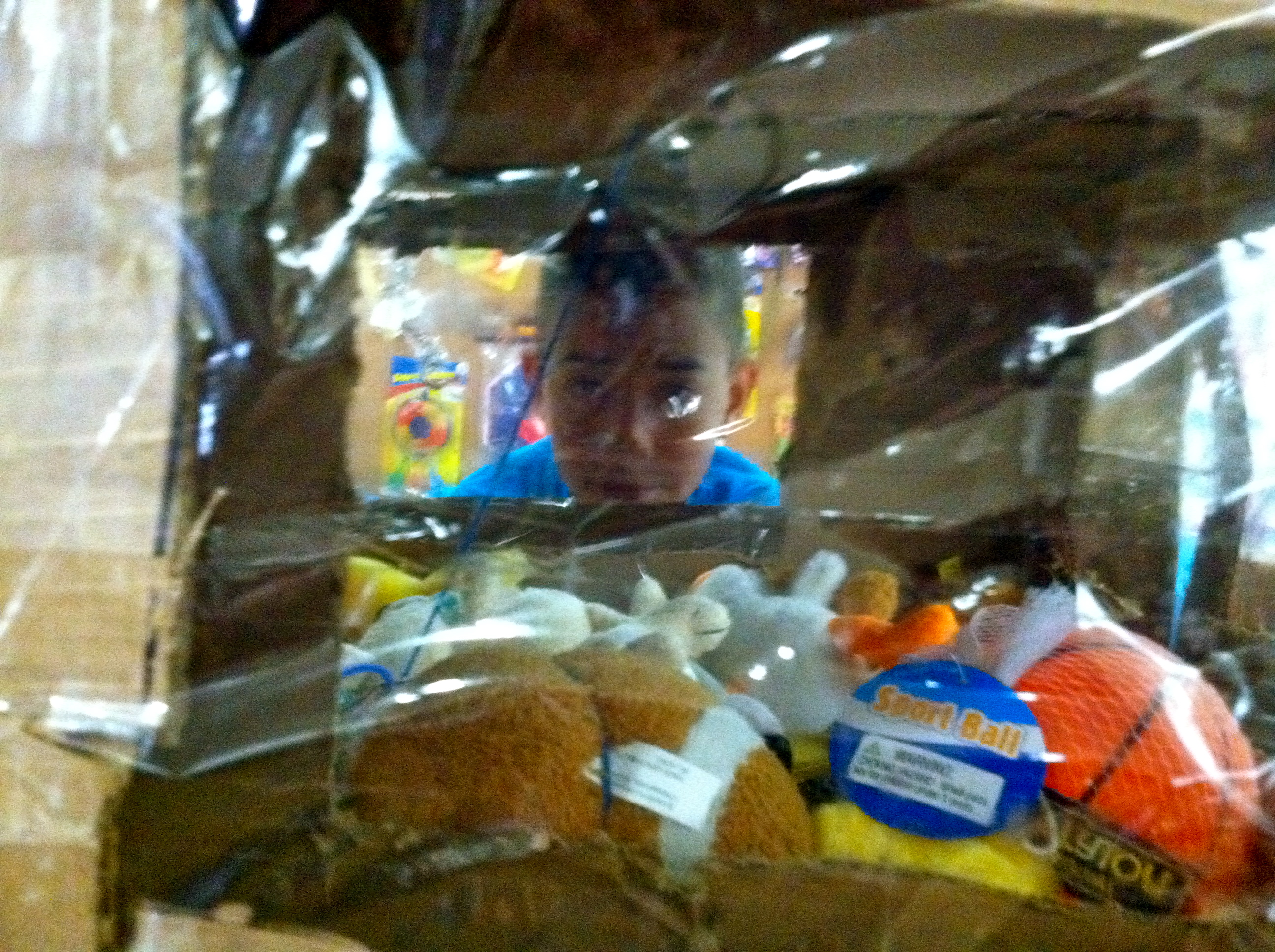
Inside Caine’s Arcade

Hanging with Caine and Nirvan at DIY Days @ UCLA.

This past fall, I wrote a blog post for the Cooney Center about my experiences at the annual DIY Days conference at UCLA.  In that post, I wrote [emphasis added in bold]:

“Many of the people I met are deeply invested in new ways to approach the role of media in children’s learning ecologies.  I believe that various projects presented at DIY Days (including R<3S and another very special project I’ll share in a later post) have deep implications for […] problematizing and improving education processes and outcomes in the U.S. and internationally.”

That very special project was Caine’s Arcade.

This morning, I’m beaming because the collective digital bits of the Internet have enabled the rapid spread of the story of Caine’s handcrafted analog world, in the form of a 10-minute movie by producer/director Nirvan Mullick.  As I write this, the Caine’s Arcade Scholarship Fund has raised over $70,000 for his college education.  I’m sure that before the day is over that number will be much closer, if not have surpassed, the $100,000 target.

Not only did I get to watch an early screening of the short film in October, but I also got to have a bit of the Caine’s Arcade experience.  Caine’s fantastic father, George, had temporarily moved most of Caine’s cardboard constructions to the UCLA library and installed them in the lobby for the duration of the day.  (Hands down, the best perk of the conference was that all of the attendees got complementary Fun Passes.)

I was so impressed with Caine’s poise and passion, so taken with his father’s devotion and dedication, and so heartbroken at the thought of Caine sitting patiently for customers that never came (except for Nirvan’s serendipitous visit) that I promised to visit Caine’s Arcade in Boyle Heights that weekend.

Having spent some time with Caine and his mentors (and having played his truly amazing cardboard Skee Ball machine), I can tell you that it’s not just the power of a child’s imagination that built Caine’s Arcade.  That romantic notion masks the role of the supportive adults in Caine’s life, just as DIY (or Do-It-Yourself) can mask the social and cultural context enabling things to get done only when we Do-It-Ourselves.  The overly simplistic view of Caine as a child outside of the adult realm masks the fact that Caine set up in front of his father’s auto parts shop largely because he needed to accompany his father to work on the weekends.  There are no playgrounds nearby in the primarily industrial area surrounding Smart Parts Aftermarket in Boyle Heights.  Caine’s Arcade exists now in the imagination of millions of people across the world, but no one should forget that it also exists in a very real way at the intersection of three main LA freeways.

Caine’s Arcade is a timely and brilliant example of how our society needs to rethink the ways of doing and thinking that connect children to larger bodies of knowledge and allow them to share their creations with a larger public.  A child’s “learning ecology” includes all of the environmental factors, people, and materials that a child learns though across in-school, afterschool, and out-of-school settings.  Researchers, designers, and educators in the Digital Media and Learning community are deeply invested in studying children’s learning ecologies, including the folks at the Cooney Center and my collaborators at USC.  There is no way that Caine could have developed the skills and experiences he gained through his arcade in his formal education.  The passion and interests that drove Caine’s expression and experimentation deserve to be scaffolded and seeded with new informal learning opportunities.  These skills and competencies that Caine is developing deserve extra love because they don’t directly translate to any report card, cannot be rewarded by any standardized test, and their impact cannot be measured in an immediately verifiable quantitative way.

At Caine’s Arcade, the value isn’t just in the product, but in the process.  Yes, the tickets are redeemable for prizes (I still have the neon green plastic tube bracelet with the glittery water sloshing around inside that I won from Caine.  I couldn’t bear to redeem my tickets for one of Caine’s old Hot Wheels car, even if Caine insisted that he’d outgrown them.)  But seeing Caine climb inside his machine and hand roll those tickets out to me – that’s priceless.  What does have a price tag though is a college degree.  You can’t redeem a Fun Pass for a college degree, so I strongly suggest you contribute here.

Weirdos and What-Nots at the USC Annenberg Innovation Lab Summit 2012

This post originally appeared on the blog of the Joan Ganz Cooney Center.

On Friday, March 30, the Cooney Center-partner USC Annenberg Innovation Lab held its annual Innovation Summit.  The day-long event brought together the sometimes overlapping, sometimes divergent worlds of academia, private sector, non-profits, and artists to play hands-on with new prototypes and applications from the Lab.  We had the pleasure of having JGCC Director of Research Lori Takeuchi join us for the event.  Besides the Cooney Center, the Lab’s collaborators include IBM, DirectTV, the Los Angeles County Museum of Art (LACMA), and international partners such as France Telecom-Orange and transmedia producers The Alchemists.

The Summit focused on two themes: Rethinking Urban Settings (led by Prof. Anne Balsamo) and Experiments in Participatory Cultures (led by Prof. Henry Jenkins.)  The projects presented reflected Annenberg’s interdisciplinary work in communication, journalism, engineering, cinema, art, education, business, and music.  Much of the “playful” work the Lab is conducting intersects with the Cooney Center’s research on children, youth, media, literacy, gaming, and civic engagement.

Ernest Wilson, Dean of the Annenberg School for Communication and Journalism, spoke about valuing team members that play and think in sometimes unorthodox ways.  He advised the attendees in his opening address that, “one of the keys to creating innovative environments: hire weirdos.”  I immediately thought about some of the great Muppet weirdos and what-nots, and how we can all draw a lot of inspiration from the Muppet Labs.  At the Lab, we try to avoid the hazardous-yet-hilarious explosions like the ones set off Bunsen and Beaker.  We do though throw a lot of stuff on and at the wall (including full wall projects of Twitter data sets, colorful Post-It notes, and sometimes squishy magnets.)

Muppet Labs with guest star Gilda Radner.  Gotta love Jim Henson for imagining a world with no IRB approvals necessary to superglue Gilda’s head to a rope.

We believe that the scientific method is inherently playful, and the Lab often invites outside social scientists, researchers, and designers to challenge and play with us in exciting ways.  One such person is Kati London, the Lab’s new Innovator-in-Residence.  Kati is a social and civic game developer and executive producer for Zynga New York.  Last year, Fast Company named her the “24th Most Creative Person in Business” for her work in making human-computer interaction seamless, screenless, and social through games.   Kati also teaches in the Interactive Telecommunications Program (ITP) at NYU Tisch School of the Arts.  At Annenberg, Kati will be lecturing and leading workshops on autonomous objects, networked data, participatory design, and assessing learning outcomes from games.

I was fortunate to be involved in two presentations at the Summit, as a research assistant for the Lab’s area of research in children, youth & media and as winner of the Lab’s CRUNCH Design Challenge competition.  In the morning, I helped lead a project demo through the conceptual design of our Flotsam Transmedia Play Experience, based on the Caldecott Medal-winning wordless picture book by David Wiesner.  Our Lab’s Managing Director, Erin Reilly, has written a great blog post on our work-in-progress, which has brought together undergraduate, masters, and Ph.D. students across the communication, music composition, marine biology, engineering, and interactive media departments at USC, as well as educators, parents, and children from the LA area.  This summer, we plan on writing up a white paper framing new logics of transmedia by sharing our working definitions for transmedia play and learning, and it’s complementary nature to transmedia storytelling.  Other lab research in the area of children, youth & media include development of the PLAY! (Participatory Learning and You) framework and spreadability of its approach through The PLAYground, a transmedia learning platform.

In the afternoon, I was honored to present on behalf of my partner (Saranyaraj Rajendran, a USC M.S. student in electrical engineering) and myself on our project, the Theia Handheld Braille Aid, which won this year’s CRUNCH Design Challenge.  The competition brings together interdisciplinary teams to design creative technological solutions for pressing human needs.  Raj came to the project through his work in India, home to the world’s largest population of blind people at 15 million.  I approached the project though my interest in literacy, assistive technology, and accessibility.  Here’s a short concept video on Theia, and you can find out more about the project here.  As the Lab’s new Startup-in-Residence, we hope in the future to work in partnership with readers and teachers of Braille to develop a device that supports real-time interaction, inclusion, independence, and increased research towards putting “reading within reach” for learners with visual impairments of all ages around the world.

Lastly, I wanted to reflect on a quote from the Summit that I find helpful for framing the innovative research that the Cooney Center supports around digital media and learning for diverse learners.

Amy Heibel, LACMA’s Associate VP for Technology and Digital Media spoke about how museums are “public places for people to engage with ideas that are longer lived than themselves.”  Museums around the world are at the forefront of developing immersive educational media experiences for all children across social class, race, ethnicity, language, gender, and ability. Through these public spaces and the communities that gather there, children have the potential to participate in constructing, deconstructing, and reconstructing ideas that came before them and ideas they will leave behind for future generations.  (Speaking of artifacts from past generations, does anyone else remember the Sesame Street 1983 classic, Don’t Eat the Pictures, shot at the Metropolitan Museum of Art?)

As we move into the summer and next school year, we at the USC Annenberg Innovation Lab are excited to continue our collaboration with the Cooney Center and blend our shared interests in participatory practices and transmedia play and storytelling in relation to learning.  Look out for many more new developments at next year’s Innovation Summit!

‘This Ain’t Montessori’: (Mis-)Appropriating Pre-K Education at DML 2012

froebel gifts

froebel gifts

This post originally appeared on the Joan Ganz Cooney Center Blog here.

The title for this post is borrowed lovingly from Antero Garcia, doctoral candidate in Urban Schooling at UCLA and chair of the Innovations for Public Education conference track at DML 2102.  At DML, Antero presented a stellar talk entitled, “This Ain’t Montessori: Mobile Participation in South Central High School” in a panel on issues around inclusion in online and offline learning environments.

I was instantly intrigued by the “ain’t Montessori” line, and learned that it was a reaction to the opening keynote speech by the sage John Seely Brown, whom both Antero and I respect immensely.  (JSB is the former Chief Scientist at Xerox PARC and, full disclosure, current Chairman of the Advisory Board of the lab I’m affiliated with at school, the Cooney Center-partnered USC Annenberg Innovation Lab.)

Having been stuck in the airport Thursday morning, I unfortunately missed JSB’s keynote, but luckily you too can watch it here to understand what Antero was referencing.  To summarize, JSB discusses how the philosophies of Maria Montessori and modern Montessori education (note: not necessarily the same thing) might be scaled to challenge the current dominant social practices and institutional structures around learning, digital media, and technology.

Antero’s “ain’t Montessori” line was meant to problematize JSB’s (as-presented) rather romantic notions around Montessori education, and point to how a “Silicon Valley”-inspired model of Montessori education is not necessarily globally or culturally appropriate.  Taking Antero’s lead, I’d like to use this space to problematize not just JSB’s presentation of the role of Montessori in universally “cultivating the entrepreneurial learner,” but also to specifically call attention to the absence of early childhood educators and scholars in the DML space, and why it should matter to you.

JSB argued that through the lens of Montessori’s philosophy, today’s digital technologies hold unparalleled possibilities as “curiosity amplifiers.”  Montessori teaching values tacit learning, or the development of key practices, habits, and “know-how” that can only be learned through personal experimentation.  However true, Montessori is NOT the only model of early childhood education that values embodied play and learning.  While the guys at Google might have grown up and thrived going to schools inspired by the pre-WWII teachings of Maria Montessori, how about inviting to the metaphorical sandbox another Italian pioneer of early childhood education, Loris Malaguzzi of the post-WWII Reggio Emilia movement?  I’ve argued in a recent article in the Journal of Early Childhood Literacy that there’s much the DML community can learn from Reggio Emilia-inspired practices, too.  It is unfair to reduce early childhood education solely to Montessori when other models might in some ways be a better philosophical fit for framing certain discussions in the DML space.

Let’s avoid stagnation purely based on sagacity.  While I applaud JSB for taking early childhood education seriously, I don’t want his thesis to go unquestioned by his audience, who may or may not have a deep understanding of theories and research in early childhood education.  I don’t buy that Montessori-inspired pedagogy alone is the magic answer for fostering new processes and connections around education reform.  I do believe that bringing a plurality of voices, representing a wide range of early childhood education philosophies and professionals gets us somewhere closer.  I take issue with reductively and symbolically talking about preschool when it becomes talking for the diverse players in the preschool world who can speak for themselves (about Montessori and much more) if given the stage.

The Cooney Center is at the forefront of mobilizing scholarship, policy, and practice in the area of digital media and learning.  As part of the Center’s Bridging Learning initiative at the USC Annenberg Innovation Lab, we are exploring the ways that early childhood and elementary school-age children learn across their media ecosystem.  Key to that initiative is recognizing that the opportunities to participate in this cultural convergence start before children begin kindergarten.  Appropriating Pre-K philosophies for K-16 education reform might isolate Pre-K teachers, students, and parents from the kinds of rich and interesting conversations had annually at DML.

Now, who wants in on my DML 2013 panel submission on the “ABCs of DML”?

_

Some more resources on Reggio Emilia that might apply to thinking about digital media and learning:

The Wonder of Learning Exhibit

“The Hundred Languages of Children” (Book)

“Working in the Reggio Way: A Beginner’s Guide for American Teachers” (Book)

“In the Spirit of the Studio: Learning from the Atelier of Reggio Emilia” (Book)

DML 2012 Presentation

I had the pleasure of organizing a panel at this past weekend’s MacArthur Foundation Digital Media and Learning Conference in San Francisco.  The panel focused on “Universal Designs for DML: Innovations for Students with Disabilities.”

Below is a PDF of my presentation slides and notes, as well as a description of the panel and abstracts from my fellow panelists: Alexandra Dunn from the Upper Canada Distric School Board; Juan Pablo Hourcade of the University of Iowa, Sooin Lee of Project Injini, James Basham of the University of Kansas, and Maya Israel of the University of Cincinnati.

PDF: Meryl Alper DML 2012 Presentation: Promoting Emerging New Media Literacies Among Young Children with Blindness and Visual Impairments

Universal Designs for DML: Innovations for Students with Disabilities

Organizer(s): Meryl Alper

Participants: Meryl Alper, Alexandra Dunn, Juan Pablo Hourcade, Sooin Lee, James D. Basham, Maya Israel

ABSTRACT: Special education and Universal Design for Learning (UDL) have been nearly absent from DML discussions.  Students with disabilities, as well as their teachers and parents, are often marginalized from these crucial conversations, widening the digital “participation gap.”  This innovative panel will begin to fill this gap by exploring practices, products, and methodologies based in UDL.  In doing so, we hope to champion a plurality of paths to inclusive cultural and civic participation.  We will present research from a variety of disciplines (computer science, communication, special education), a range of stakeholders (industry developers, speech and language pathology school practitioners, academic researchers), and multiple international perspectives.

Alexandra Dunn: This presentation focuses on “smart inclusion” – a UDL toolkit for students and educators including emerging technology (e.g., interactive whiteboards, iPads, Nintendo DSi), in conjunction with what is generally thought of as “special needs” software/hardware.  Acting as a catalyst for inclusive classroom practices, this approach is “necessary for some, good for all.”  Combining technology with good instruction enhances educational and social participation for ALL students including those with disabilities.  This initiative is data-driven with outcomes in both teacher training and student social and academic participation.

Meryl Alper: This presentation bridges the underexplored relationships between blindness and visual impairment and the New Media Literacies in order to better account for how expanding notions of literacy are enmeshed with the affordances of specific technologies.  The presenter will draw parallels in the “hacking” of technology to better suit young children with disabilities, as well as the issue of declining literacies in the form a much debated US “Braille literacy crisis.”

Juan Pablo Hourcade: In spite of great improvements in early diagnosis and interventions, most children diagnosed with Autism Spectrum Disorders (ASD) are unlikely to live independently when they reach adulthood. We have been conducting research on novel computer-based interventions with the goal of promoting social skills. Working with more than 40 children with ASD, their teachers, and other stakeholders, we have iteratively developed a set of activities based on applications that run on multitouch tablets. Our observations suggest these activities increased pro-social behaviors such as collaboration and coordination, augmented appreciation for social activities, and provided children with novel forms of expression.

Sooin Lee: Touch-based technology opens the door to independent play for toddlers and young children with special needs. What role do game designers play in developing high-quality learning experiences that can be used by parents and therapists to address the cognitive, fine-motor, and speech delays of children with special needs? The presenter will share her best practices for designing award winning learning games that are fun to play and accessible to children with autism and developmental delays.

James D. Basham and Maya Israel: Panelists will discuss research and design of a mobile learning system for iOS devices dubbed the Interactive Field Investigation Guide (iFIG).  Based on the instructional design framework of UDL and gaming technology, the iFIG integrates learner analytics and instructional protocols to provide all learners with an individualized, accessible, and engaging learning experience.